Goals

- Upgrade the existing system with new functionality,

- Increase speed and reduce error rates in vacation, transfer, and HR management processes,

- Integrate an educational service for current employees to save resources on hiring and onboarding,

- Implement a new UI framework, aligned with other products within the enterprise ecosystem.

My role

- UX/UI/Product design
- User research
- Wireframes / Prototypes
- Design hand-off
- Reviews
- Presentations
- Feature proposals
- Design system integration
- Team consultancy

Team

- Product Owner
- Analysts
- UX/Product Designer
- 3 Developers

Tools

Figma, Miro, Jira, Confluence, ChatGPT, Kendo UI

Duration

2.5 years

Result

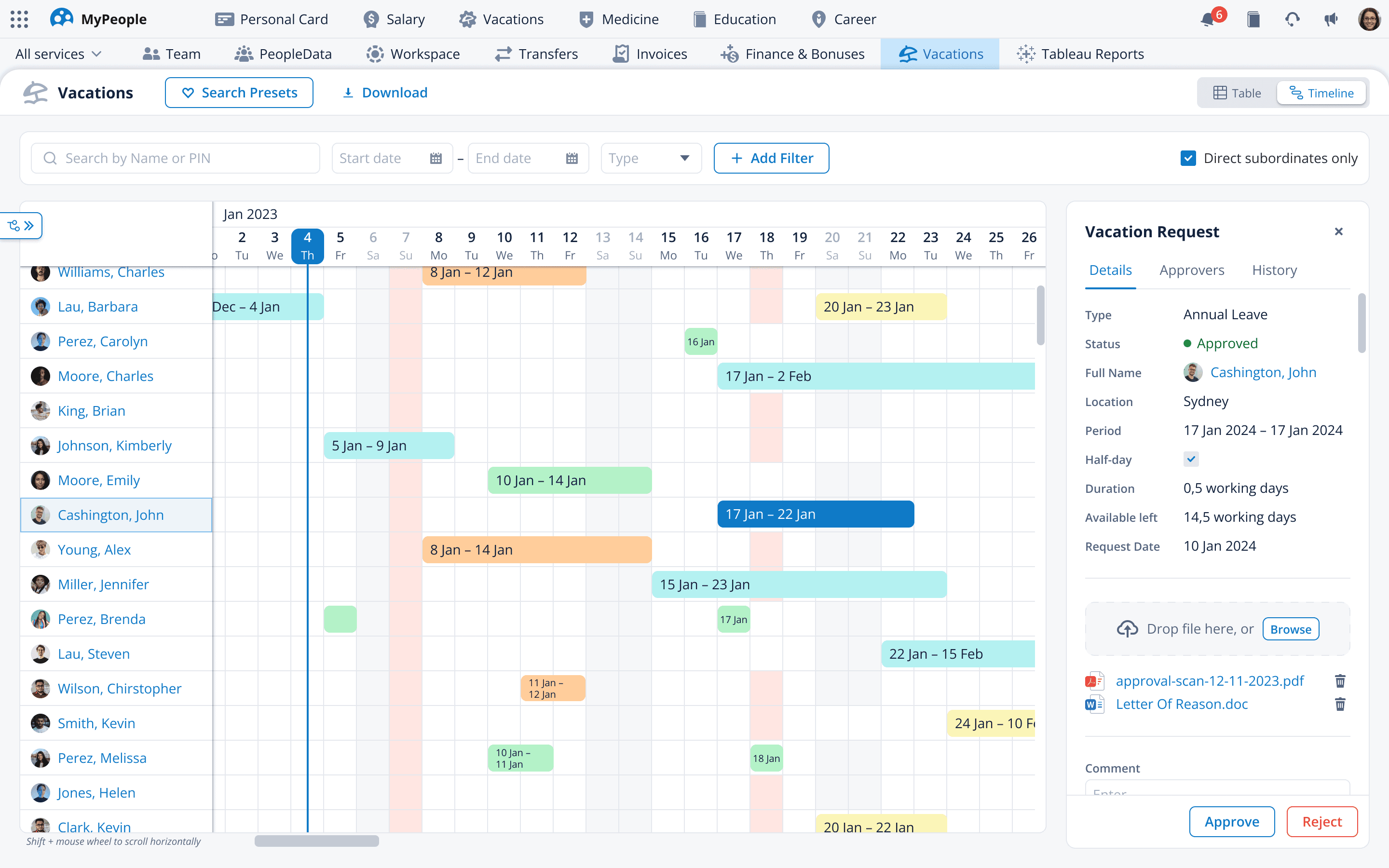
- Streamlined processes for vacation and transfer creation and approval, reducing time for each by an average of 60%,

- Implemented an enterprise design system, boosting the speed of design and development processes by at least 50%,

- Improved integration with other systems, accelerating the time to perform actions there (e.g., embedded iframes).

Users

- 5,000+ users in the Manager role (HRs, managers of all levels),

- 20,000+ users in the Employee role.

Challenges

- Many connected modules whose databases were not properly adapted to work well within the new framework,

- Numerous user roles requiring different (sometimes opposing) features and UI,

- Conscious reuse of UI assets that had to be both adaptable for all cases and consistent across functionalities.

Tools

Figma, Miro, Jira, Confluence, Kendo UI

Result

- Streamlined processes for vacation and transfer creation and approval, reducing time for each by an average of 60%,

- Implemented an enterprise design system, boosting the speed of design and development processes by at least 50%,

- Improved integration with other systems, accelerating the time to perform actions there (e.g., embedded iframes).

Users

- 5,000+ users in the Manager role (HRs, managers of all levels),

- 20,000+ users in the Employee role.

Challenges

- Many connected modules whose databases were not properly adapted to work well within the new framework,

- Numerous user roles requiring different (sometimes opposing) features and UI,

- Conscious reuse of UI assets that had to be both adaptable for all cases and consistent across functionalities.

Show design process

Task

It can come from:

Client
Big conceptual undefined requests.

Product Owner
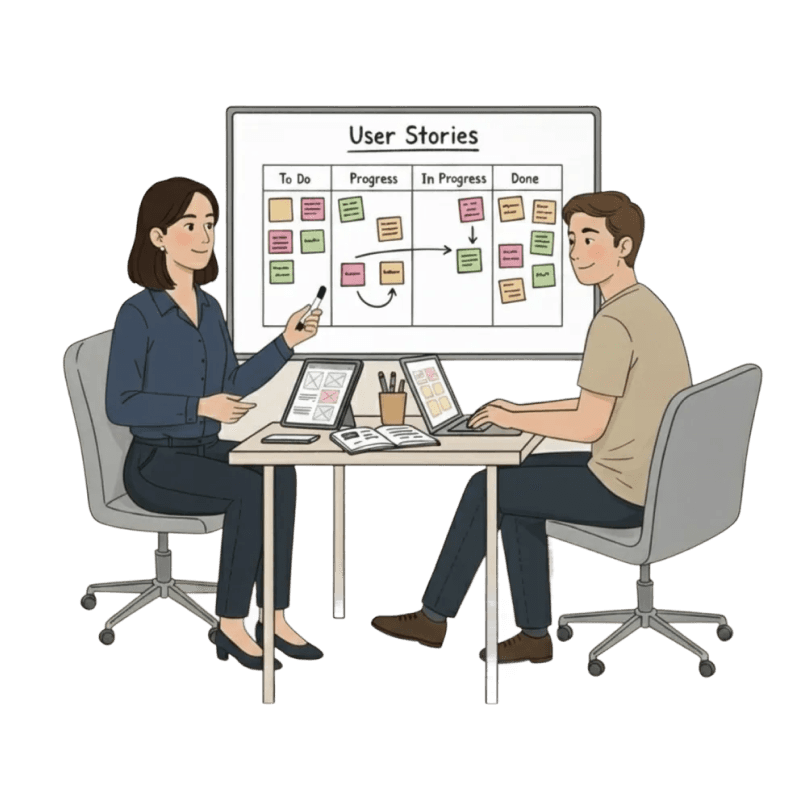
User stories that need analysis, targeted on business needs.

Myself
Features and tunings to improve UX of final users.

Tasks can be:

Simple
You just do it. All the other team knows exactly how to do it.

Complex
Nobody knows what the result will be, me included. These 30% of tasks - fuel for number of ideation workshops, analysis, iteration, user research and hours of discussions.

Draft & users

If task is "simple", I have two checks of wireframes:

With Product Owner
If design answered business requirements.

With developers
If we can simplify design (without losing in UX) to speed up time to market.

If task is "complex", plus to those two I also have:

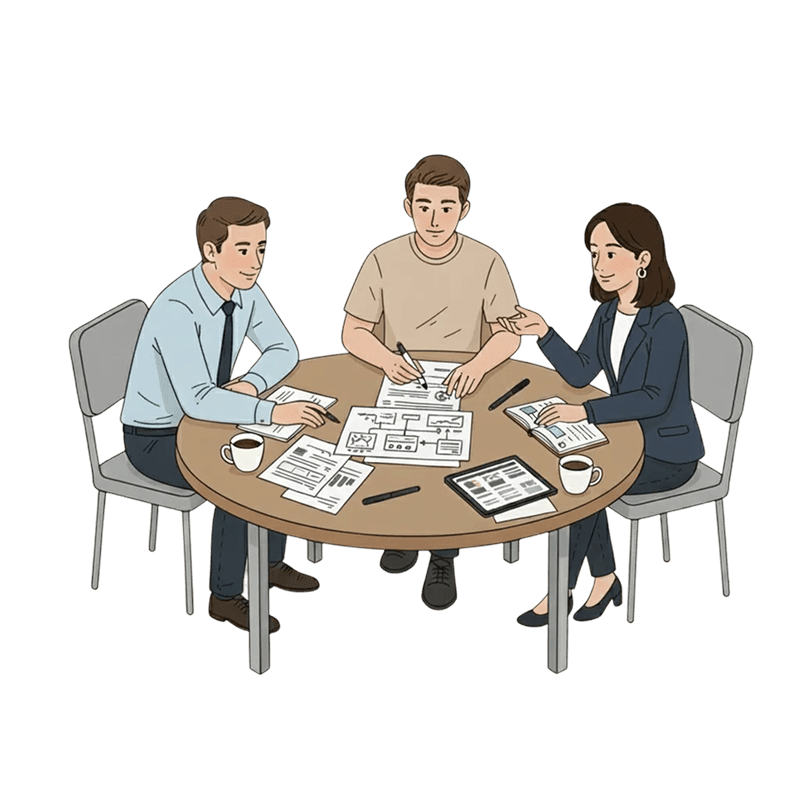
Brainstorm session with client
Sometimes it about them reinventing the whole business process. Sometimes it me to guide them into the right direction.

User interviews
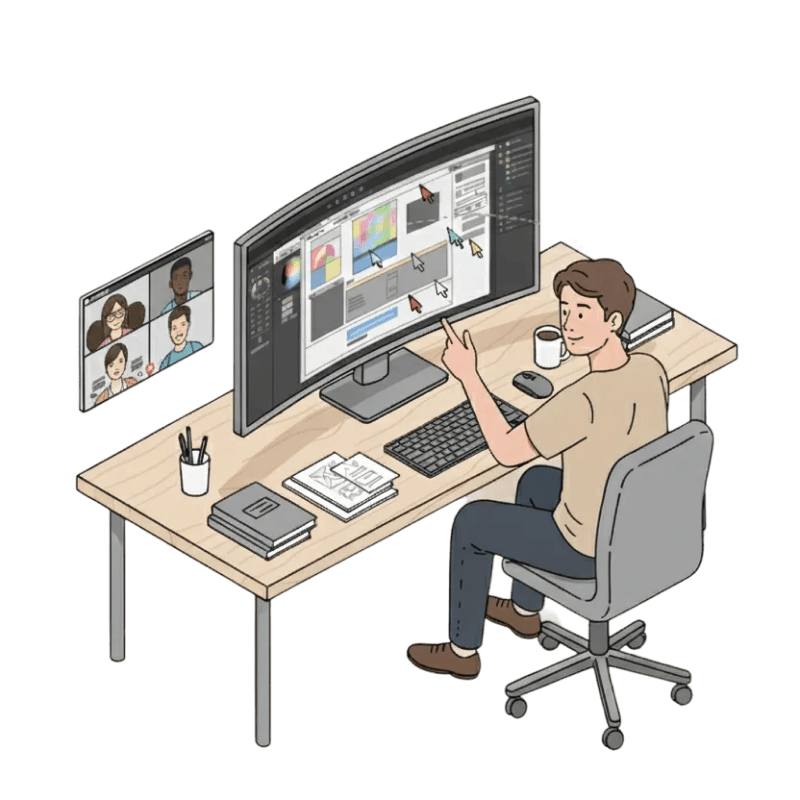
30-minutes calls with users where they perform some tasks on clickable prototype. Depends on my hypothesis proven or rejected, the Draft stage can have another iteration.

UI & hand-off

90% of time
I work with predefined design systems. So I build the entire UI from its components.

10% of time -
some unique solutions where discussion with developers is needed.

After we discussed the final design with the team, I prepare mockups (flows, comments, documentation if needed).

When someone starts to work on this task in sprint they invite me on the tasks kick-off, where we check everything we need to do.

After the task is ready, I have a design review during the task demo or myself on the dev stage.

Release

As I work in-house, I have control on what happens after the release.

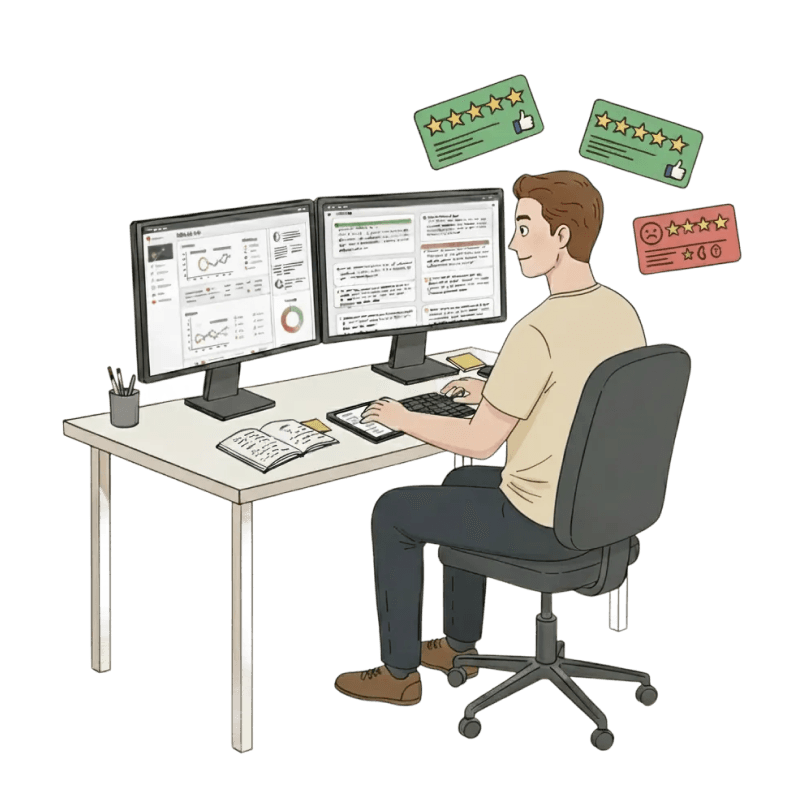
If feedback is negative and prioritized, I analys it it and go on the next iteration of design.

If feedback is positive, I can propose that new feature/pattern/flow for another product in our ecosystem. Yes, I test design innovations on selected products before the whole-ecosystem implementation.

Show design process

Show design process

Task

It can come from:

Client
Big conceptual undefined requests.

Product Owner
User stories that need analysis, targeted on business needs.

Myself
Features and tunings to improve UX of final users.

Tasks can be:

Simple
You just do it. All the other team knows exactly how to do it.

Complex
Nobody knows what the result will be, me included. These 30% of tasks - fuel for number of ideation workshops, analysis, iteration, user research and hours of discussions.

Draft & users

If task is "simple", I have two checks of wireframes:

With Product Owner
If design answered business requirements.

With developers
If we can simplify design (without losing in UX) to speed up time to market.

If task is "complex", plus to those two I also have:

Brainstorm session with client
Sometimes it about them reinventing the whole business process. Sometimes it me to guide them into the right direction.

User interviews
30-minutes calls with users where they perform some tasks on clickable prototype. Depends on my hypothesis proven or rejected, the Draft stage can have another iteration.

UI & hand-off

90% of time
I work with predefined design systems. So I build the entire UI from its components.

10% of time -
some unique solutions where discussion with developers is needed.

After we discussed the final design with the team, I prepare mockups (flows, comments, documentation if needed).

When someone starts to work on this task in sprint they invite me on the tasks kick-off, where we check everything we need to do.

After the task is ready, I have a design review during the task demo or myself on the dev stage.

Release

As I work in-house, I have control on what happens after the release.

If feedback is negative and prioritized, I analys it it and go on the next iteration of design.

If feedback is positive, I can propose that new feature/pattern/flow for another product in our ecosystem. Yes, I test design innovations on selected products before the whole-ecosystem implementation.

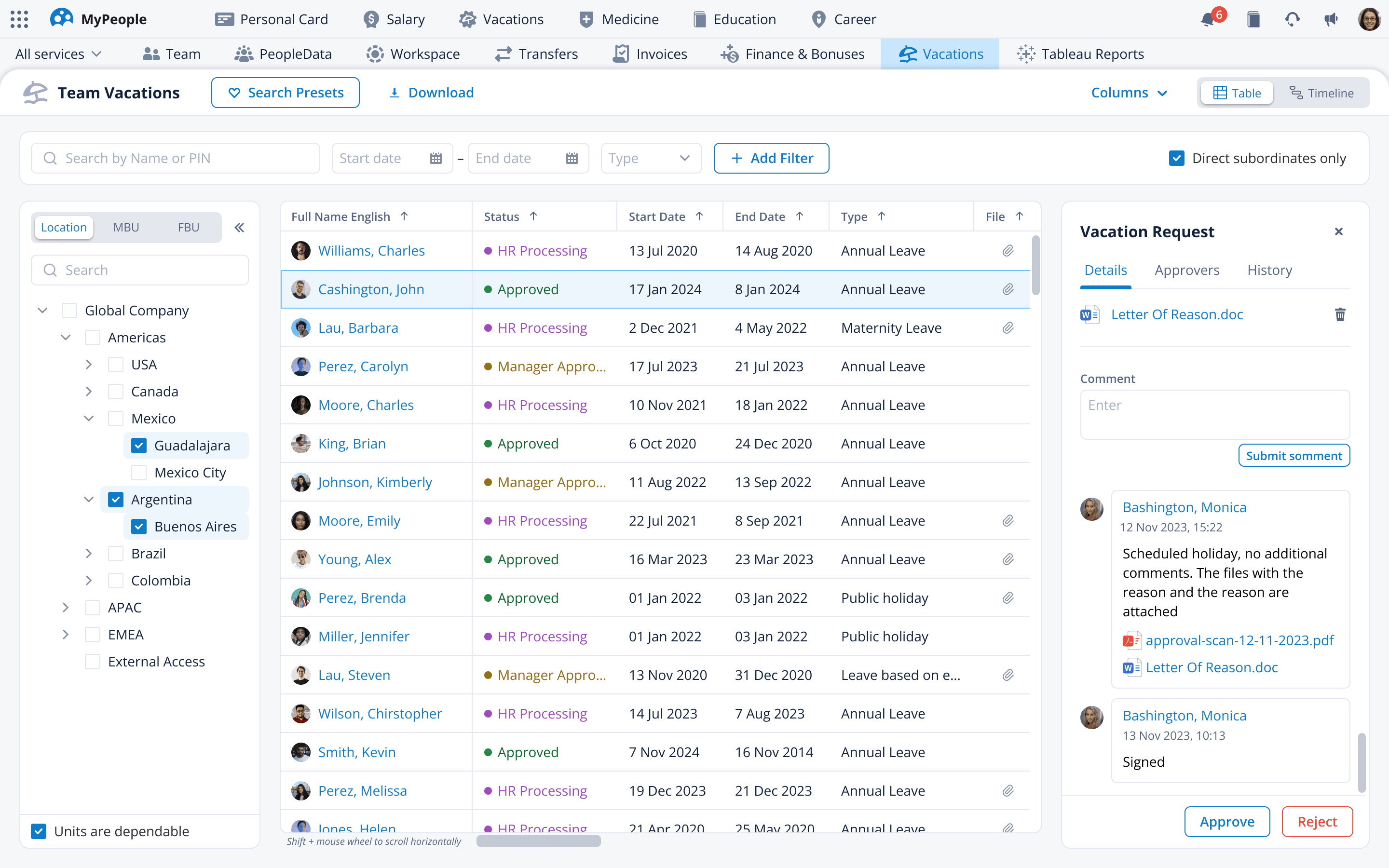
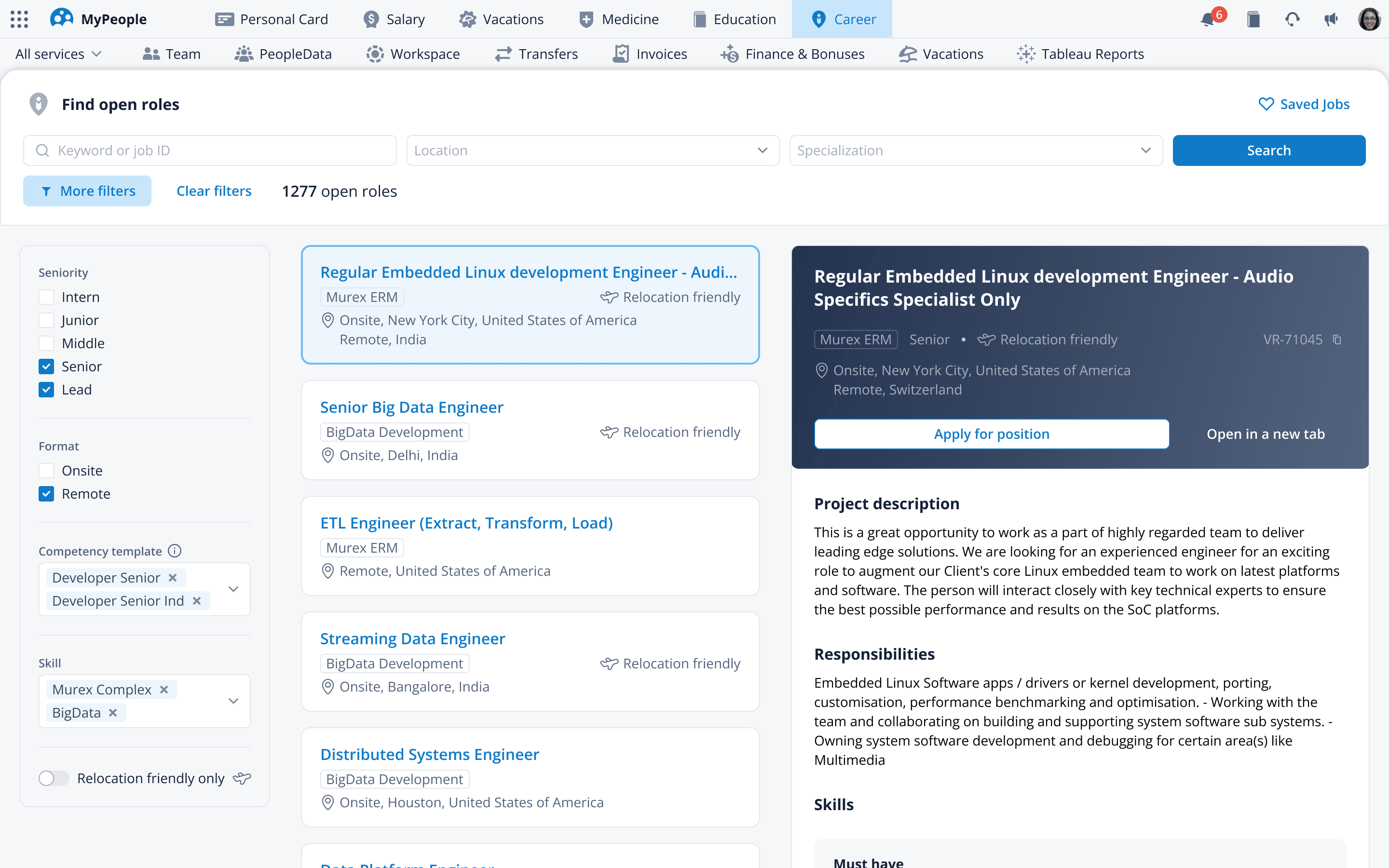
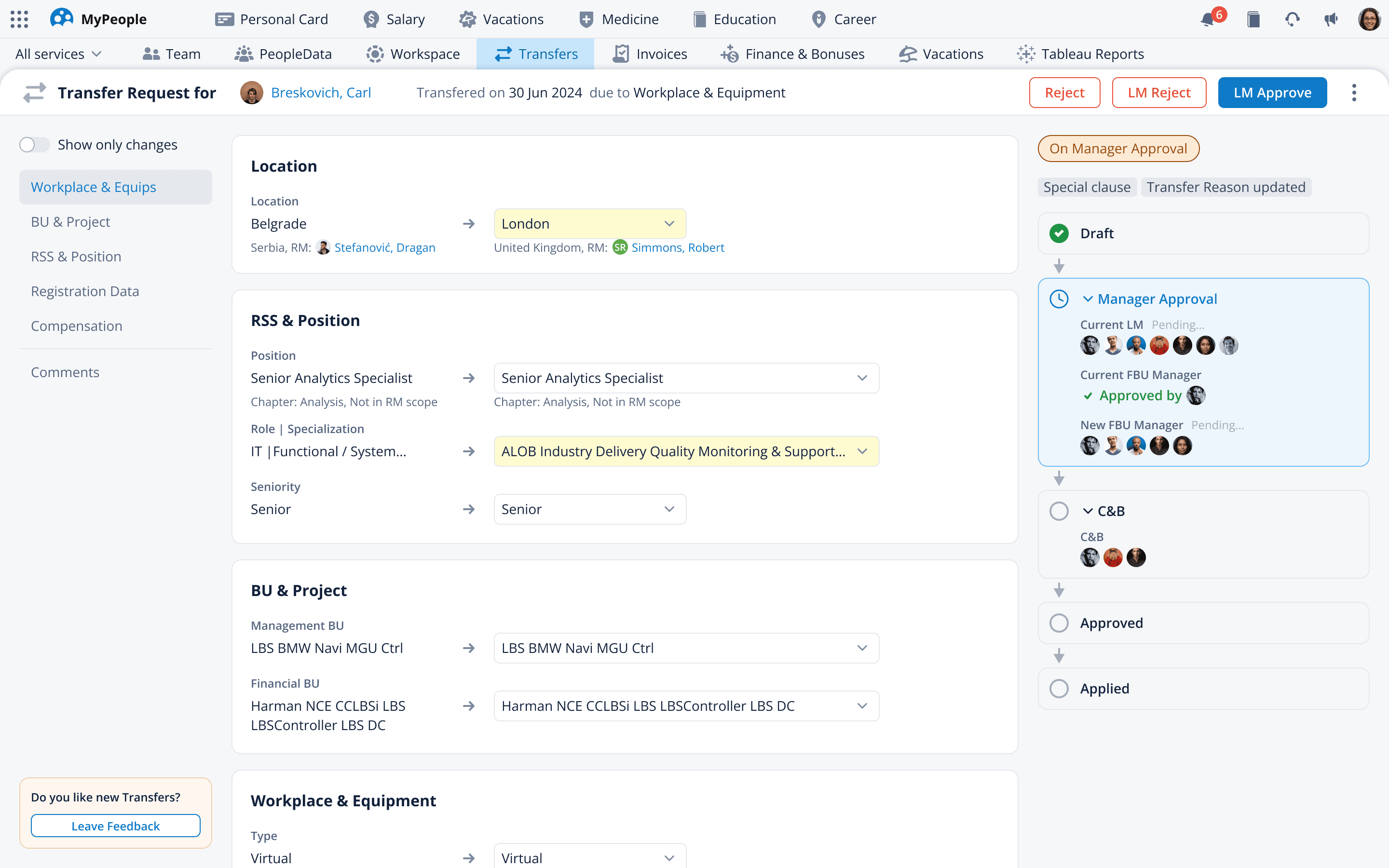
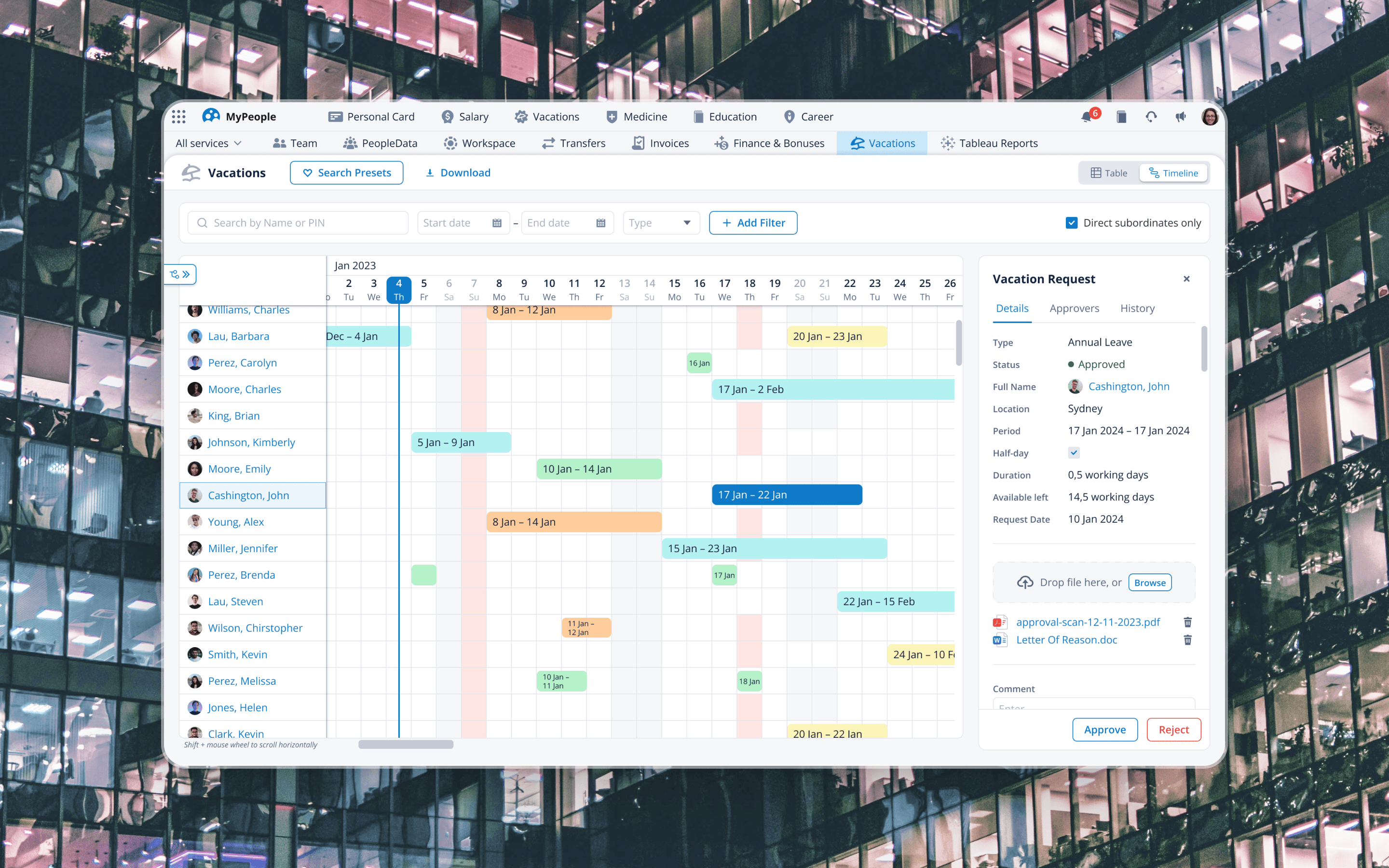
If you've seen one system for people management, you've probably seen them all: salaries, vacations, transfers, business units, insurance, growth paths, and so on. Of course, details vary depending on the company and system. In my case, I worked with a fully developed internal system that was transitioning from a legacy framework to a new one, ensuring its unification with the common design system.

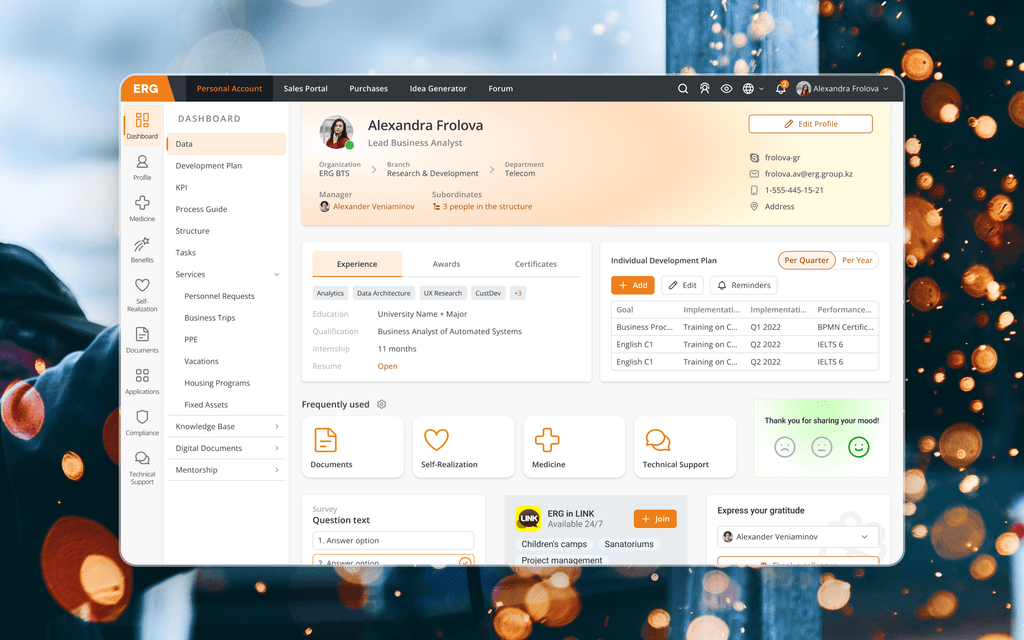
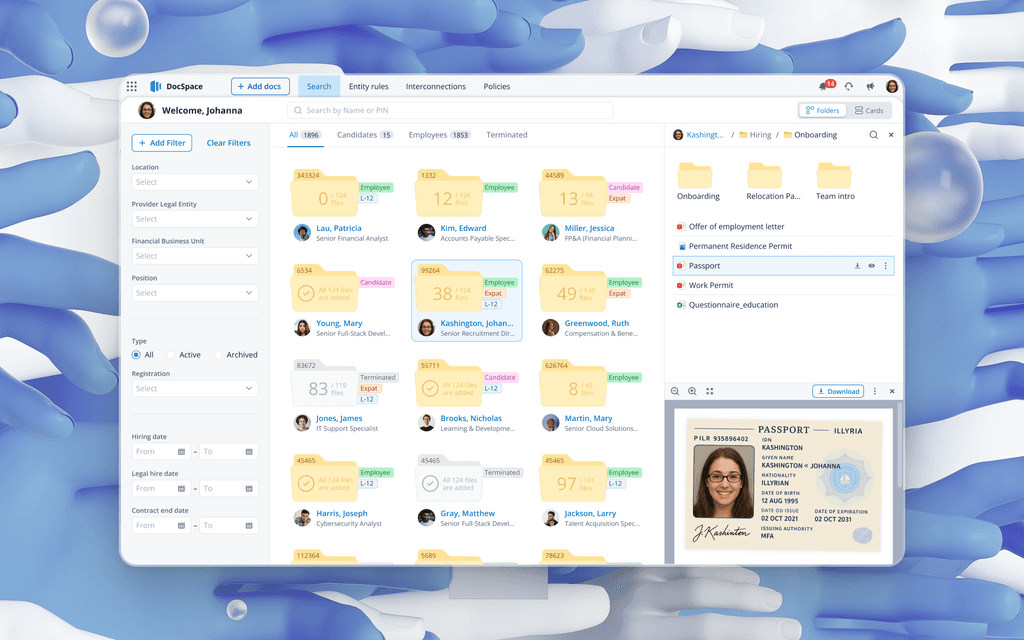
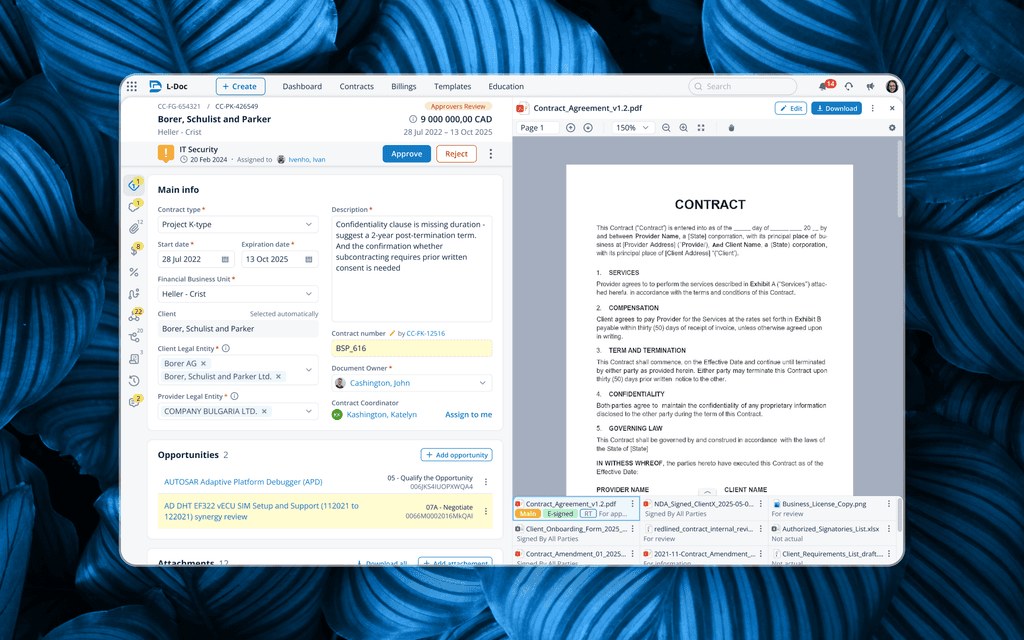
As I led UX development for the entire cluster of our ecosystem's products, I was aware of all the differences and similarities between them. This was a perfect opportunity to bring in everything that had already succeeded in my other products. I adopted a large number of UX and UI patterns from EDMS, aligning the two systems almost completely and reducing the need for user reeducation to nearly zero.

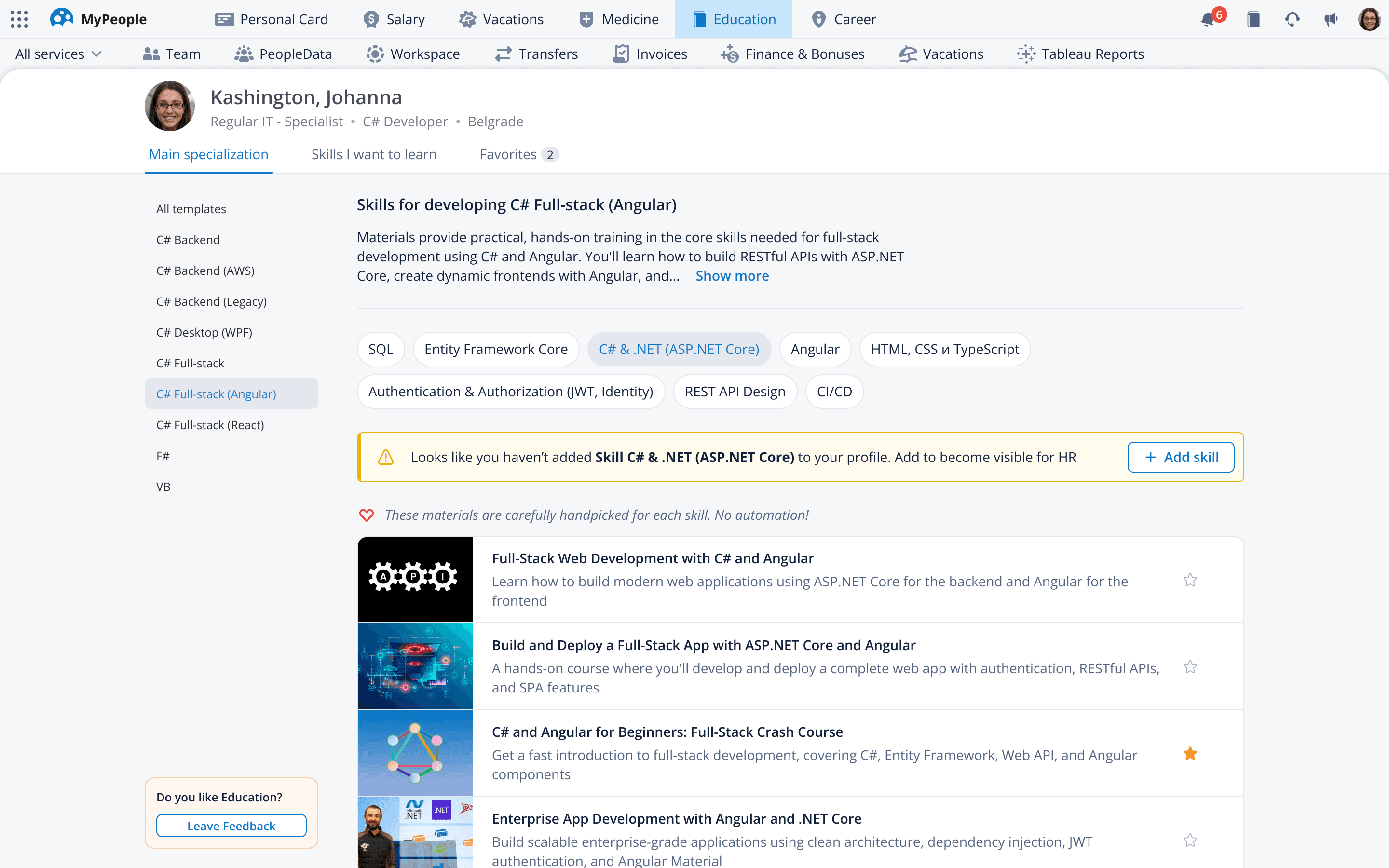
What was unique about this system was our experiments with educational features. We tried to create an internal digital university with career development paths. Sounds good, but for what? Didn’t the company already hire skilled specialists?

Here's the company-specific context: its main model is outstaffing. I myself work internally, not as outstaff. The issue is that when outstaff employees cannot be assigned to projects, it benefits the company financially. However, when employees leave and new hiring and onboarding are required, the costs are too significant to ignore.

60%

less time spent on the improved process of creating and approving employees' vacations and transfers

50%

average time boost in design and development speed after implementing the design system and adopting successful patterns from other systems

60%

less time spent on the improved process of creating and approving employees' vacations and transfers

50%

average time boost in design and development speed after implementing the design system and adopting successful patterns from other systems

60%

less time spent on the improved process of creating and approving employees' vacations and transfers

50%

average time boost in design and development speed after implementing the design system and adopting successful patterns from other systems

This "internal university" showed employees how they can develop professionally to become even more competitive for clients and partners. Each person has a personally tailored career path, depending on their goals. If it sounds like a good place to implement AI, you’re right - but initially, we tested it with hand-picked, human-created learning paths.

In the end, I had a fully functional enterprise system covering almost every people management operation. Even after leaving this project as a full-time team member, I remained responsible for checking UX consistency and ensuring synchronization with other systems, collaborating with the designers who continued working on it.

NDA disclaimer: The images shown on this page are drafts, concepts or high-fidelity wireframes and do not reflect the final product. All names, numbers, titles, charts, and other data are fictitious.

NDA disclaimer: The images shown on this page are drafts, concepts or high-fidelity wireframes and do not reflect the final product. All names, numbers, titles, charts, and other data are fictitious.

NDA disclaimer: The images shown on this page are drafts, concepts or high-fidelity wireframes and do not reflect the final product. All names, numbers, titles, charts, and other data are fictitious.